WW84, FOUR

We have a continuation of the Wonder Woman character. Is she still a Nine?

She’s very physical, of course. The thing she values most, her superpowers, are threatened by her wish. In the opening sequence, when she’s a child, she’s physically driven and very Nine-ish, very much the Diana we remember.

To wish for Steve’s return, especially when you don’t know that you’re actually wishing for something that can come true, is a move any Enneagram number could follow. Lost love and broken hearts.

Steve, however, causes problems for a Nine. He magically inhabits another man’s body without his permission or knowledge. I suspect a Nine, a Body Type, would find that egregious. In order to keep Steve, Diana must accept the loss of her prowess. Again, I have doubts that a Nine would roll with this. The failing of her own body would be unacceptable, as would the injustice of using someone else’s body. Either the production team has written a Diana who violates her own character, or they’ve changed Enneagram numbers on her.

What number, if any, would follow these conditions? Well, not a Body Type. Probably not Head, either. Too many rules are broken. Heart is the only possibility. Diana puts everything aside for love.

They’ve made Diana a Four. Her loneliness, her depression, consume her. She barely can generate a friendship with Barbara. Her fighting is peremptory. The only physical joy we see is her flying, which could be attributed to emotion and her memory of Steve. And when she meets the Body Donator — the man who was Steve — she seems nostalgic rather than horrified. It’s about her and her feelings, not a consciousness of him. 

I was sad that more of this movie wasn’t about WW and Cheetah. The change from Nine to Four would be responsible for that. A Nine story would look outward more; the Four story looks inward.

Presumably now that she’s made peace with Steve’s passing she can resume her duties as Wonder Woman. If they’re financed for another movie, will they flip her back to a Nine?

CHEETAH, SIX

We see more of her as Barbara Minerva. Cheetah gets one fight scene in full furry regalia, and she seems like a character that is only rage, not personality, at this point. But, cool name, cool title.

Her alter ego is stereotypically geeky and awkward. She can’t walk in high heels until after the wish. No one listens to her until after the wish. She’s metaphorically invisible. She’s physically vulnerable to harassment. Honestly, these traits are so cliche it’s painful. I, and I don’t think I’m alone, expected more originality from the WW84 team.

This is who we have, though, and this is who Wiig had to play. What did she have to work with?

She had niceness. Everyone who wishes, according to the Rules of the Magic, loses what is most important to them. Max Lord risks his son. This is a tangible fear and an actionable one: I want to keep my son. Pascal is given a playable trait. Wiig is given: I want to keep my pleasant outlook on life.

Which Enneagram number is the nicest? She’s socially unable to connect, so not a Heart Type. The high heel thing suggests she’s not a Body Type. The brainy job suggests she’s a Head Type. Not a Seven — they’re not awkward like that.

A Six, because Wonder Woman, the person she wishes to emulate, is a Nine. Sixes move to Nine in strength. And, I’m surprised to realize, Sixes in their purest form are indeed the nicest number.

The Boy in the Iceberg

As the very first episode of Avatar: The Last Airbender this one contains a lot of Rules of the Magic events. We have a fantasy world that needs explaining. The introduction before the credits carries a lot of weight, but we’ll need more for this initial look.

ONE

We meet Katara and Sokka, sister and brother, as they fish ice-laden water in a canoe. This entire episode is very good at summing up a character in one scene. Sokka’s humor, how he becomes the slapstick butt of the joke often, is introduced. Katara as sincere, serious, and unsure of her abilities, are shown right away. And we learn something about water bending. Boom.

TWO

An unexpected flow of water puts the canoe in danger, then crashes it. Certainly this is Trouble, but is it enough? After Katara and Sokka become stranded on a little iceberg they argue. As Katara becomes angrier, she unconsciously bends water behind her, making large waves. A sizable iceberg rises from the ocean. This is also Trouble.

Perhaps the combination of these events is the Two. Perhaps only one of them. Because this episode is continued, and this is not a complete Enneagram story arc, I can’t know for sure. Often the Two and Three can’t be labeled until I can look at the end and see the whole movement.

THREE

Inside the large iceberg is another, a blue bubble with a boy suspended in the middle. The arrow marking on his forehead glows. He’s alive. This discovery of Aang could be the Three.

Katara attacks the berg, breaking it open, and it explodes with a beam of light shooting into the sky. This magical moment could also be the Three.

FOUR

I think those are our only options, because the next scene shows Zuko and Uncle Iroh on their Fire Nation ship, searching for the Avatar. Again, each character is perfectly introduced. At this point we only know Zuko as a villain, but we see his drive. Iroh’s gentility helps soften Zuko’s obsessiveness.

And then we officially meet Aang and Appa. (Appa!) We learn the magic of air bending. We sense that Aang is avoiding something.

Everything we see is information we’ll need later in the series. The Southern Tribe has no men in the village and no benders. The war with the Fire Nation has been going on for one hundred years, and Aang knows nothing about it. Zuko must find the Avatar to restore his honor and return home. It’s all presented in a way that feels organic, not like exposition.

SWITCH

Again, I’m guessing without the rest of the story, but it seems natural that the episode break would come at the Switch. Aang and Katara accidentally trip a trap in an abandoned Fire Nation ship, sending a beacon into the air. Zuko, using a spyglass, sees them and the village. He is headed right for them. Cliffhanger! Stay tuned until next week.

MR. POTTER, FIVE

He’s the villain. He’s stingy, cross, and infirm. He’s ambitious. Without George he practically turns Bedford Falls into Vegas. He certainly fits a lot of tropes: greedy capitalist villain, angry physically-challenged villain, crotchety old man villain. If he had a mustache, he’d twirl it.

Underneath all of that stereotyping, do we have an Enneagram? When he realizes that Uncle Billy has left the bank deposit in the newspaper, does he have a brief moment, a flash, of sympathy? (Well, no. He takes an evil glee in knowing a secret.) When he and George are the only two to keep their heads during the bank run, he admires George as more than a competitor. And when he offers George a job, tempting him to sell the Savings and Loan for an easier life, isn’t he almost successful because he knows what pains George the most? Either he’s just the Devil, or he’s a man who has watched George over the years. Does he have — gasp — fatherly feelings toward George?

Let’s make some guesses. Potter physically declines with age, which in the most general and anecdotal way possible suggests a Head Type.

Five, Six, or Seven? Not a Six. He doesn’t seem to have a moral code, a black-and-white view of the world. He’s bad because he’s stingy and cheap, not because some great wrong offends him.

He’s a Five. A Five’s besetting sin is stinginess. They’re just knee-jerk that way. They’re also uncanny in their observation of others. Potter’s understanding of George, of what drives him and of what he fears, fits this. And the Bedford Falls he creates without George is just a mash-up of others’ vices. A Five would become overwhelmed with a bunch of competing desires and step away, letting everyone do as they want. As long as order was maintained a Five would turn hermit and escape.

Also, a Five’s social clumsiness can turn them into a curmudgeon. They want to be liked but other people are so baffling! Potter is a Five pushed to all the extremes.

UNCLE BILLY, TWO

He’s forgetful. When Mr. Bailey dies no one suggests that Uncle Billy could run the Savings and Loan. He’s a beautiful, loyal heart, but a manager he is not.

Uncle Billy loses the deposit — forgets it — because he wants a piece of Mr. Potter. He just has to tell him off, which causes him to leave the money behind, momentarily forgotten. Is this a trait that helps identify his Enneagram? Anyone would want a righteous poke at Potter. Not everyone would let their emotion out until the deposit was secured, though.

And when George yells at him . . . oh, doesn’t it break your heart? It’s because Uncle Billy, in a small way, deserves it. He’s a grown man who can’t be trusted with a grown-up’s responsibility. However, it’s possible that Billy is mentally challenged. No one spells it out, but that’s how he’s played. Without George, in the angel’s version, Billy is committed to a mental institution. No one’s asked him to step up, no one’s depended on his support. On his own he can’t cope.

I’m tempted to say that Uncle Billy has no Enneagram. He has the strings on his fingers, and all else could be attributed to challenge rather than personality. Is he a Head Type? A Body Type? Probably not. As a Heart Type is he a befuddled Two? His sweet enthusiasm, and his love for George, are priceless. 

Actually, that’s the clue that he’s a Two, albeit a challenged Two. Sevens, which is George, tend to collect Twos as precious sidekicks. (Notice that Clarence is also a Two.) Without George, Billy has no purpose or direction.

The Fifth Husband, pages 5-6

In honor of the feast day of St. Thomas Becket, martyred in Canterbury Cathedral in 1170, I present these pages. As always, the published book handles the screenplay formatting efficiently. The blog post, not so much.

PRIORESS, an elderly nun surrounded by pampered doggies, nods at Alys.  She is a Very Important Person who is always treated with deference.  Feeding table scraps to her dogs is the NUN’S BOY.

                                   ALYS 

Mother Prioress, my pleasure. Another woman on the journey will be most welcome.

Continue reading “The Fifth Husband, pages 5-6”

Scrooge, page 82

REVERSE as Cratchit walks away. We see a whole gaggle of
Spirits looking in the window at Scrooge’s efforts.
Satisfied, they disperse.
PULL OUT to show a bird’s eye view of the Spirits who walk
London, now leaving Scrooge’s presence and looking for new
lost souls to bemoan.
PULL OUT FURTHER to the Lone Spirit on the spire of St.
Paul’s Cathedral. Beneath him London is coated in a hazy,
coal-burning smog, yet he sits in the sunlight. Shading his
eyes, he looks off.
SPIRIT-POV. In the distance, leaving the city, is a train,
its engine sending steam into the blue.

Continue reading “Scrooge, page 82”

Tiny Tim’s Song

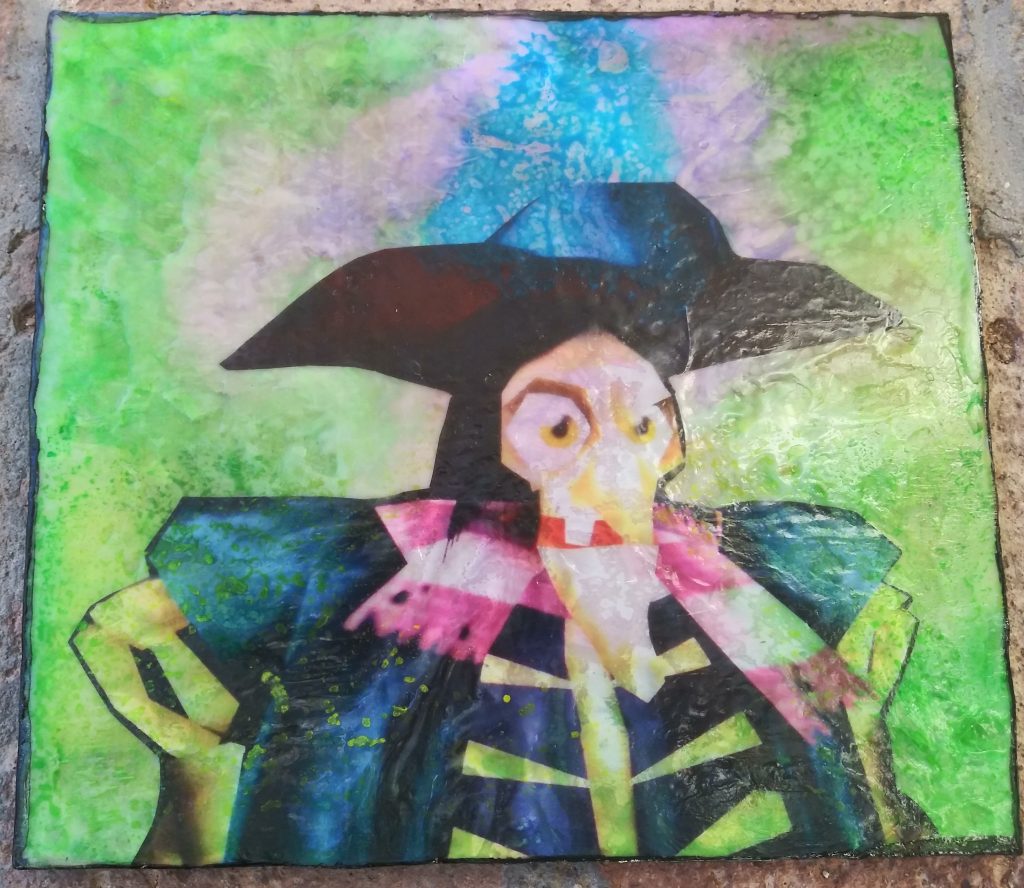
Listen at bandcamp. I did apply a saturation filter to this photo. Encaustic can be so difficult to capture the color and texture.

1 When the bakers start their fires
and the stuffed goose casts its lure
and the baskets full of chestnuts loll
like gentlemen at doors,

We thank our gracious Father
for the feast laid at our feet
and all the meat and fish and fruit
He’s given us to eat.

2 When the girls dance round in furs
and the sharp men doff their hats
and the lamplighters tap fire to wick
like mischievous black cats,

We thank our gracious Father
for our friends and family
and all the health and wealth and love
which makes us so happy.

3 When the church bells toll their call
and the people gather in
and the Bible tells of sinners whom
the Good Lord has forgiv’n,

We thank our gracious Father
for His Son whom Mary bore
and all the blind and deaf and lame
that Jesus may restore.

4 When the dead man fades to dust
and the spade turns up his bones
and the mourners in black armbands face
the rest of life alone,

We thank our gracious Father
for the angels bending near
to bring our lost and lonely prayers
to God’s eternal ear.

5 When the boys give glad noel 
and the snow drifts on the air
and the mothers in the workhouse sing
to babies who aren’t there,

We thank our gracious Father
for the stable and the star
that hope in dark and troubled times
may beckon from afar.