EVA STRATT, ONE

Please don’t read about Stratt if you don’t want spoilers for “Project Hail Mary”.

My first instinct was to call her a Head Type, but she might be a One. Rules are very important to her. She’s in charge of saving the human race and she won’t shirk her responsibility. A One with a vision is indefatigable. They make a good leader when survival is on the line because they aren’t swayed by feelings. Their coldness is their strength.

Also, Stratt’s karaoke scene suggests that little twinkle that a One has. Her job is too serious to let her dip into humor, but for a small moment we see that she’s got a hidden trait.

Stratt as a One and Grace as a Six leads to the confrontation they have. Both are rule-following Enneagram numbers. Grace, who’s convinced he’s not fit for space, won’t budge. Stratt, who has no other option than Grace for her team, will do anything to advance her mission, including drugging and forcing Grace to go. Not many numbers would act so ruthlessly, but a One with a purpose will.

In Stratt’s final scene, we see how implacable she is. Years have passed; her face is lined with age. She’s sailing on a freezing body of water. This is the state of the world as the sun dies. I doubt she’s in the arctic; she’s probably near Hawaii, although the movie doesn’t specify that. All this time, she’s continued on mission. I actually get chills thinking of how dedicated she is and how her belief in Grace comes to fruition. It’s a beautiful moment when she holds Rocky’s sculpture and gives a slight smile. For Stratt, this is the equivalent of jumping up and down with joy.

You don’t have a story without Stratt and her stringency. A One is an excellent choice for a difficult character. She’s implacable. Perhaps some think her villainous. However, all of her decisions feel true to her nature. Her believability is essential.

ROCKY (THE ERIDIAN), TWO

Rocky is a rock-shaped alien. I don’t think it’s a spoiler to say that; the trailers were generous in showing him.

Animated characters are similar to Rocky’s design: a voice actor provides one aspect of his personality; the illustrator (or in this case, the puppeteer) provides another layer. They can have an Enneagram, and so can Rocky. However, because he has no human-style face, the voice carries more of the load.

James Ortiz gives Rocky a very energetic voice; he loves problem-solving and is curious, asking many questions. He also has a dry sense of humor. He’s loyal to his species, his mate, and his new friend Grace. Rocky has a generous heart.

He could be any of the traits: Head, Heart, or Body Type. Because he’s the only Eridian we get to know, we can’t tell if he’s more physical than others, more sympathetic, or more cerebral. He’s our only example. With so many options, it’s tempting to call him a Null.

That wouldn’t be fair, though; he clearly has a personality. We’ll need to judge him by human standards.

His wit and exuberant physicality suggest a One. His adventurousness suggests a Seven. His sorrow at being alone in space suggests —

A Two. His little xenon sculptures are his Two Collection. The last half of the movie makes clear that Rocky is a Heart Type. I’ll say no more than that.

RYLAND GRACE, SIX

I saw Project Hail Mary in theaters, and then recently rewatched it on streaming. I would say that the second viewing was a little slower because I knew what Grace needed to discover, but overall it was still a great movie.

Grace is no Body Type; he has no confidence in his physical abilities. He’s also no Heart Type; he’s unaffected by appeals to the good of humanity. He’s a Head Type, one who’s removed himself from professional society. This is part of what makes his Hero’s Journey compelling. He’s no hero, not even in his own mind.

We’re left with a Five, Six, or Seven. 

He eventually comes to see himself as an adventurer, as any Seven would, and he ends up being quite resourceful in a pinch. It’s a stretch, though, to call him a Seven. He’s not excited enough at his possibilities. A Seven would love to go into space.

Because his pre-mission choices are driven by fear, he could be a Six. He enjoys being of service to his students, and is willing to speak honestly to them. His classroom is all the world he needs, and he’s happy that it’s a small, isolated environment.

Ah, there we go. At first, his duty is to his teaching job. Later, his duty is to Rocky. A Six can do anything when they feel a sense of duty. It’s what keeps a Six from becoming mentally paralyzed by worry. Grace is a good example of the possibilities of a Six, from their darkest characteristics to their most glorious. The story of how he finds his bravery is very compelling.

EDDIE AND PATSY, FOUR AND NINE

Okay, bear with me, lol. I’ve given the Sherlock Holmes tag to the Absolutely Fabulous duo. Let me explain.

When I was watching the Cumberpatch/Freeman Sherlock, their relationship suddenly made me think of AbFab. One of the team is a silly basketcase (Watson, as he’s written for this series), and one is completely cool. Now, Patsy is no detective mastermind, but within the fashion-oriented world of AbFab, she is a consulting savant.

Yes, I’m comparing Patsy Stone to Sherlock Holmes.

And Edina Monsoon, with all of her fake Buddhist chanting and colonic remedies, to Dr. Watson.

They are the antithesis of the Sherlock archetype. It’s impossible to get any further from it. I find it hilarious that, while watching a Sherlock show, I was reminded of these two. However, Eddie and Patsy are a Four/Nine duo living in the best aspects of their Enneagrams.

Patsy, as the Nine, is stoic and dispassionate. Eddie the Four feels everything — everything — for the both of them. Their lifelong friendship, even though it portrays a codependency, is loving and charming. The Cumberpatch/Freeman Sherlock is building something very similar, except the Enneagram numbers are flipped. A Four who feels nothing, as Sherlock does, will never build a healthy partnership with a Nine who carries the emotional load.

As you can see, this post is just an excuse to continue my complaint against the Sherlock series. It’s based, though, in a dedicated passion for AbFab, a ridiculous wonderment of female devotion. I continue to rewatch it every few years. Saunders and Lumley have created something true, even if it’s exaggerated.

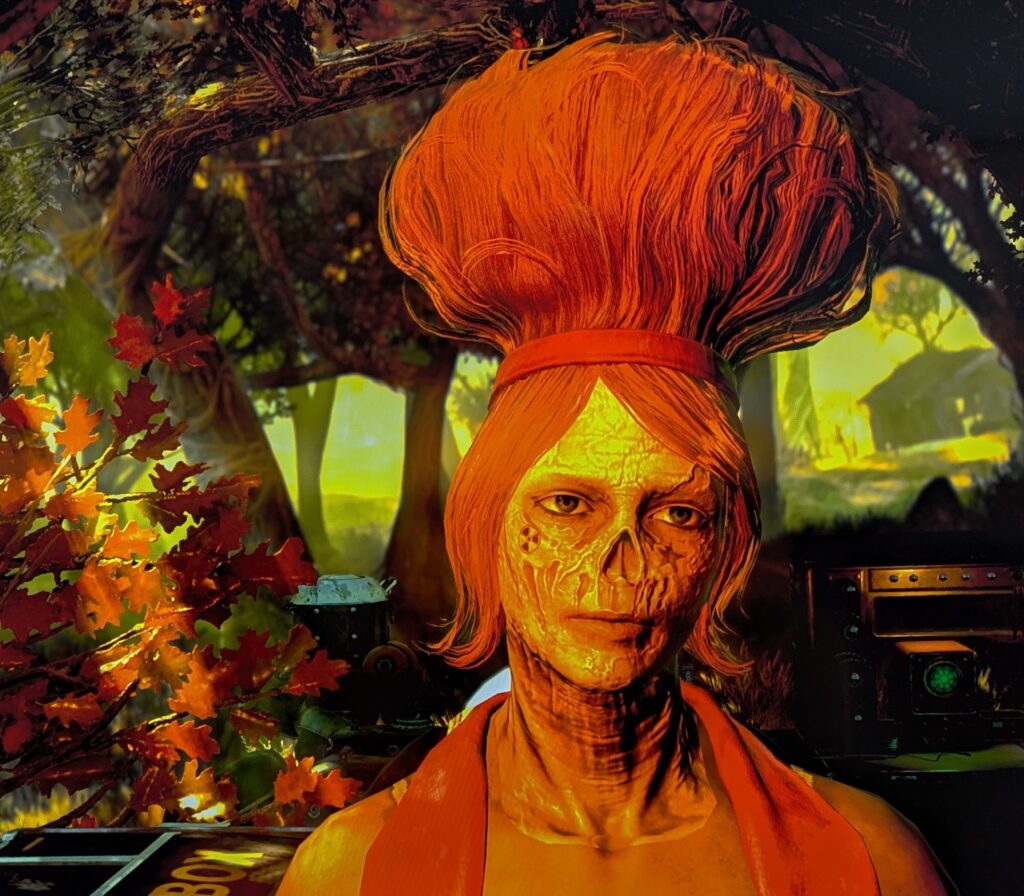
(And even more hilariously, I’ve created an Eddie toon in my Fallout 76 playthrough. She’s a ghoul — a wrinkled, noseless, undying social reject. Like a classic episode of AbFab, Eddie pursued a questionable beauty treatment with unexpected consequences. It’s all good, though. She looks refreshed.)

DÓNAL FINN’S MORIARTY, THREE

To make Holmes’ archnemesis his friend in Young Sherlock is a stroke of genius. For the majority of the season Moriarty is a straightforward companion. Only at the end do we see James become tempted by a different path.

Moriarty is no Watson, who’s a sidekick. James behaves like a hero with a daring streak. Sometimes he is sharper than Sherlock and more confident. And he’s not confined by pesky rules.

I could go Eight because of his leadership and boss-ness. I could go Three because of his charm and unwillingness to fail.

Ah, wouldn’t that be interesting! A Three who becomes a villain.

And if Holmes is a Six, as I’ve predicted, then we have strength/weakness numbers as buddies. James the Three would move to Sherlock’s Six in strength, making him a more law-abiding character. Holmes moving to Three in weakness would be more of a woe-is-me character, which we see in this season.

I enjoyed this show, but I’m not hyperventilating for the next installment. However, these Enneagram numbers excite me for the possibilities. I hope they continue developing the leads along these lines.

HERO FIENNES TIFFIN’S HOLMES, SIX

Goodness, man, lol. We need an overbearing studio head to give this actor a shorter name. Oh, he played Tom Riddle! And he’s Ralph Fiennes’ nephew. Nevermind. 

Now he’s playing Sherlock Holmes in a new series, Young Sherlock, that has no connection to the 1985 Steven Spielberg movie. This is a Guy Ritchie production, the director of the Robert Downey, Jr. movie. The pedigree is obvious; this Holmes also previews his thoughts cinematically. So, is this Holmes a Seven like RDJ’s portrayal?

My gut says no. This Sherlock was traumatized as a child by his sister’s death. His lingering sorrow becomes the major plot point. Although he ends up in trouble with the law, Tiffin’s Holmes isn’t reckless like the Sherlock we expect. He’s curious and quick but he’s not as charismatic as previous portrayals.

Here’s the real twist, though: Sherlock’s partner is James Moriarty. At this point he’s not an arch-enemy. He’s his buddy crimesolver. They make a great team, and then add in our foreknowledge of what Moriarty is to become. It’s an excellent story hook.

However, Holmes is not the leader and he’s not remarkable (yet). Basically, he’s a college-aged man who has unresolved feelings about his lost sister. He’s wounded.

I want to say Heart Type, but he exhibits no envy. Is he a Nine, the heroic catchall for writers? No, he’s not particularly athletic or physical. He’s a Head Type.

Not a Seven, though. I think he’s a Six because of his tender heart. If indeed he’s a Six — someone who sees the world in black and white, not gray — he’s going to have a big problem with Moriarty as the seasons continue. Of course. That’s the point of putting them together.

Fallout Enneagram: HANK MACLEAN, TWO

At the end of Season One I looked at the four Personality Enneagrams of major characters Cooper, Lucy, Max, and Norm. Reviewing what I wrote, I’m pleased to say that the Enneagrams seem consistent between the two seasons. I wouldn’t change my conclusions.

I also briefly mentioned Hank during Norm’s review, although I concluded that we didn’t have enough of his character to make a judgment.

Well we’ve got enough Hank in Season Two, lol. My biggest question will be: is he sane enough? What is inherent in Hank’s personality, and what is a product of craziness?

Let’s start with pre-war Hank. He’s earnest and motivated. In the corporate meeting with Barb where the mind control devices are presented, Hank leans in for a better look. He doesn’t match Barb’s horror at the implications for these things. His moral compass is already wobbly.

In Vegas he’s chained to a Vault-Tec briefcase and doesn’t seem to mind. He’s obedient to the corporation’s interests, a good cog. 

Post-war, he’s happy to work toward their goals and he’s unfazed by the human deaths during his mind-control device experiments. I’m going to say that part of this is fan service to Fallout’s ethos. In the games, you can cheerfully play as a cannibal, for instance. That’s the tongue-in-cheek humor of the series. I’m not sure how much of this deranged science points to Hank’s Character Enneagram.

However, we have one small beat when Hank broadcasts (to the Enclave, we later learn). He expects that they’ll value and promote him. “When this is all over you’ll be begging me to help you.” His face at this moment is hard and serious. For me, this is the real Hank and the best clue to his character. In every other scene he’s content to be a worker bee. Here, we see his ambition. We see his anger and resentment at being overlooked. And then he’s back to his cheerfully insane personality.

This is an Envy person. He wants recognition not for his deductions or his science know-how or his work ethic. He wants it for his own status.

He can’t be a Three; a Three is naturally imbued with status and doesn’t need to seek it.

He’s a Two, and the mind control devices are his collection. That’s why he’s so content to experiment with them. He makes clear at the end of the season that he’s responsible for choosing Welch as the brain behind the devices. He likes her gentleness. All the people who wear the devices (through forced implantation) are also Hank’s collection, an extension of his original collection. They have Welch’s personality and her kind traits. Through this choice, Hank has put his stamp on the entire project.

What happens to Hank after the end of this season when, by wiping his own memory, he’s added himself to his collection?

GRAHAM, NINE

The story misdirects us on Graham’s character. He appears to be a drunken playboy. Later we learn that he’s a widower father of two young girls. He’s a serious person who lets loose when he can, which isn’t often.

He openly admits to being a weeper. He guards information about his daughters because he’s a good father, but any other personal revelations are fair game. He’s not afraid of what he feels. Like his sister Iris, Graham seems to be a Heart Type.

Or is he?

We can’t have him be another Two, like his sister; that would be bad writing. He’s not snarky enough to be a Four. I can’t see Graham as a Three. Although he’s successful, he doesn’t have that Three glow.

Graham is a Nine. He’s a caretaker. (He probably rescued small, injured animals when he was a child, lol.) Amanda’s Four personality reveals Graham’s Nine. Her insecurities are a framework Graham understands. He’s pretty sure he knows how to be in love with her. Because this is a romcom, Graham’s certainty becomes upended in the story’s Five, but the Eight and Nine prove he was right all along. A happy resolution is welcome — upbeat Christmas story is a good choice — but it also feels believable because the Character Enneagrams are well done.

Like Graham, may we all embrace our inner Mr. Napkinhead at this holiday season, bringing joy to family and friends.

AMANDA, FOUR

This is a very organized, competent, and stressed person. Her professionalism keeps her from relaxing. 

Here’s an interesting experiment: Take Cameron Diaz with her beauty and charisma away from Amanda. We’re left with a workaholic. She has a lovely home and a successful business, but no personal life. She doesn’t see herself as romantically attractive and she has constant panic attacks. Actress glamour is doing a lot of heavy lifting to round out this character. On paper Amanda is one step away from being an unlikable heroine.

Possibilities for her Enneagram number include a Four (for the swings in her emotions), a One (for her rigidity about the rules of her career), or a Six (for an inability to find the gray tones in life). Because Amanda annoys me, I suspect she’s a Four. (Personally, it can be a difficult number for me to understand.) Also, she’s just not funny enough to be a One or Six.

A Four also makes sense for Amanda’s crisis: she can’t cry. And we can see at the beginning that she doesn’t really know how to be happy. A Four — someone who feels and knows the full spectrum of emotions — shouldn’t be blocked at either end. She’s living in the middle of the bell curve, a place for a One or a Six but not a Four. Amanda’s lack points us to her Enneagram number.

MILES, SEVEN

The story requires that Miles have a broken heart. It’s how he and Iris bond. He’s such a cheerful person, though, that it’s disconcerting to see him feel sad. His spontaneous personality — singing loudly in the video store, offering Christmas fettucine — seems impervious to depression.

Miles finds so much joy in his daily life that I want to call him a Seven. His songwriting and film scoring work bring him pleasure. Being tossed into the middle of Arthur’s dinner party brings him relaxation. Although his girlfriend cruelly dumps him, he finds a way to move past her without lingering or wallowing. Life is too exciting for Miles. He won’t be bogged down by sorrow.

It’s hard to separate Miles from Jack Black. The actor’s real life personality infuses any character he portrays. Dewey Finn from School of Rock is also impulsive and bold. Miles is a dependable adult unlike Dewey (lol), but they share an authenticity. What you see is what you get. Black’s style meshes well with Miles’ happy Seven qualities. 

He also meshes well with Iris’ Two. She doesn’t need more drama in her life, and Miles is low maintenance. He’s easy to love: expecting nothing and welcoming everything.