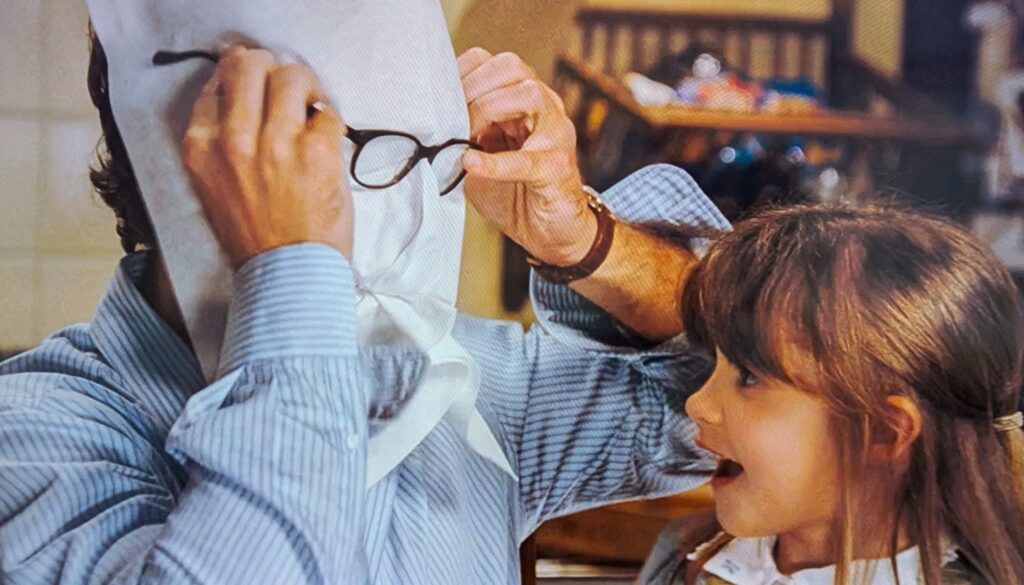
MILES, SEVEN

The story requires that Miles have a broken heart. It’s how he and Iris bond. He’s such a cheerful person, though, that it’s disconcerting to see him feel sad. His spontaneous personality — singing loudly in the video store, offering Christmas fettucine — seems impervious to depression.

Miles finds so much joy in his daily life that I want to call him a Seven. His songwriting and film scoring work bring him pleasure. Being tossed into the middle of Arthur’s dinner party brings him relaxation. Although his girlfriend cruelly dumps him, he finds a way to move past her without lingering or wallowing. Life is too exciting for Miles. He won’t be bogged down by sorrow.

It’s hard to separate Miles from Jack Black. The actor’s real life personality infuses any character he portrays. Dewey Finn from School of Rock is also impulsive and bold. Miles is a dependable adult unlike Dewey (lol), but they share an authenticity. What you see is what you get. Black’s style meshes well with Miles’ happy Seven qualities. 

He also meshes well with Iris’ Two. She doesn’t need more drama in her life, and Miles is low maintenance. He’s easy to love: expecting nothing and welcoming everything.

IRIS, TWO

The Holiday has become a Christmas staple over the past 20 (!) years. Wow, has it really been that long? Well, then, it’s certainly worthy of a look at its Character Enneagrams.

When you first meet Iris, our English rose, do you like her? On the one hand, she has a generous and vulnerable heart. On the other, she’s seduced by an obvious and repugnant con artist. She wins us all over, though, when she gets to Los Angeles and takes such pleasure in her vacation.

Unlike Amanda, whose problem is herself, Iris’ problem can be left behind in England. She forms relationships with people — Arthur and Miles — who aren’t toxic. Her routine at home was a prison. Here she’s free. Iris, named after a flower that emerges at the end of winter, blooms in warm California.

This is a Heart Type. Iris is a Two. Her caring nature leads her to overextend her sympathy for Jasper, the cad. The sweetest personality in the Enneagram, a Two, can be manipulated by vultures, and Iris is a textbook case. Jasper expects (and demands) that Iris take care of him. It’s exhausting for her; she’s depleted by their relationship. Arthur, the elderly neighbor, is the opposite. He’s a bit grumpy about any caretaking, but he accepts Iris’ help. Her easy persuading is understood and appreciated.

We’re so happy to see Iris rewarded with the people she meets. She deserves to find true friends and love.

LITTLE WOMEN (2019)

My breakdown of this version, Little Women (2019), is going to be very strange. If the filmmaker decides to take an extremely well-known story and change its ending, chaos can ensue. In this case facts about Louisa May Alcott are incorporated into the climax. I didn’t know any of these details and found the end confusing and infuriating.

It felt Author’s Message to me, and in a way it was. No matter how interesting real life information is, if you go against audience expectations, especially ones so deeply ingrained as they are for this story, you have to be crystalline. LW2019 doesn’t cross that bar.

It makes for a very interesting Enneagram pattern.

ONE

The girls are adults. The beginning of the movie starts near the end of the characters’ arcs. Okay, fresh and interesting. Jo sells a story, Amy is in Paris, Meg spends money recklessly, and Beth plays the piano. Professor Bhaer is introduced; he and Jo see each other at a pub and dance together. 

I don’t understand why this scene exists. (The movie, at two and a half hours, needed trimming.) It’s Four-ish stuff put in the middle of the opening. That’s the danger of leading with your ending, it seems.

Jump to Seven Years Earlier. Meg’s hair is burnt by the curling iron and Jo’s dress is burnt by her carelessness. Classic scene. Laurie comes to the dance and the March family meets their neighbor. Meg twists her ankle, Laurie’s carriage takes them home, and here’s Marmee, Hannah, and the bustle of Orchard House.

You see the problem here, right? This is all Four stuff! Where is our anchor to begin the story? No scene is edited to stand out.

Except one.

Continue reading “LITTLE WOMEN (2019)”

LITTLE WOMEN (2017)

Every filmed version of a beloved story will have some things that are ho-hum and some that are the best of any of the movies. For Little Women (2017), a three-part miniseries, Emily Watson’s Marmee is a triumph. Top actresses are cast as Marmee, so the field is particularly strong. Watson’s work and the script she’s given to deliver are truthful, painful, and joyous. This is a must-watch.

Some of the other choices, however, are not as strong. Let’s look.

ONE

At three hours runtime, LW2017 can add details the others leave out. We get Father March at the war right away. Both parents are much more present throughout, giving a complete family in the storytelling. 

The very first scene has the girls trimming a lock of hair to send to him for Christmas. It’s a very weird sequence, though. Close-ups, corset laces, shadows, scissor blades . . . why shoot this like soft-core thriller content?

TWO

As Marmee returns home she crosses paths in the road with Laurie in the carriage, coming to Grandfather’s house for the first time. Laurie is Trouble, of course. He disrupts the March life in many ways. It’s not the most visually descriptive or inventive Two, though.

THREE

I am utterly and totally making something up here. We see Father, still nursing the sick in the war, cover the body of a man who’s died. Again, this is a strange choice. It establishes Father, the war, and, most pertinent of all, death. We all know what happens later with Beth. Does this moment foreshadow or portend that? I don’t think so. We know nothing about this corpse and have no connection to it.

But here it is, sitting after the Two and before the Four, so it’s what we have to work with.

Continue reading “LITTLE WOMEN (2017)”

LITTLE WOMEN (1994)

(In honor of the month of December, I’ve pulled out a series that was written for my book but didn’t make the cut.)

For me, this version, Little Women (1994), is the gold standard.

ONE

Credits, beautiful music, snow, and a Christmas wreath. Time of year and era are established visually. Jo narrates. As you may know, I’m not generally a fan of narration. It’s more of a “tell” than a “show”. Because this story is a novel, Jo’s narration feels like she’s just reading to us. It’s not the worst use of narration.

Marmee comes home, chilled, and the family gathers to read father’s letter. Throughout, the film is beautifully framed, like a portrait. The arranging of the five women is evocative. You’re watching a time gone by. Perhaps you’re remembering illustrations from books you read as a child. This family is loving and close.

Also, this family is missing its father. The women are surviving and thriving, despite hardship. Whatever guidance a father would provide, whatever comfort or strength, is not weighed.

Continue reading “LITTLE WOMEN (1994)”

Miracle on 34th Street (1947)

I present to you the perfect Christmas movie. Don’t be discouraged by the black-and-white photography. It brings a pleasant sense of nostalgia, and the story will captivate you so quickly you’ll forget you’re not watching color. Let’s take a quick dive.

ONE

As credits roll the camera follows a man in a fedora who walks the streets of New York City. It’s like a charming time capsule. At a certain point I start to wonder how they managed to shoot this when steadicams didn’t yet exist. If you’ve ever pushed a camera dolly, you’ll be astounded at what they accomplished here.

Reveal that this bearded man is (probably) Santa Claus in modern clothing.

Continue reading “Miracle on 34th Street (1947)”